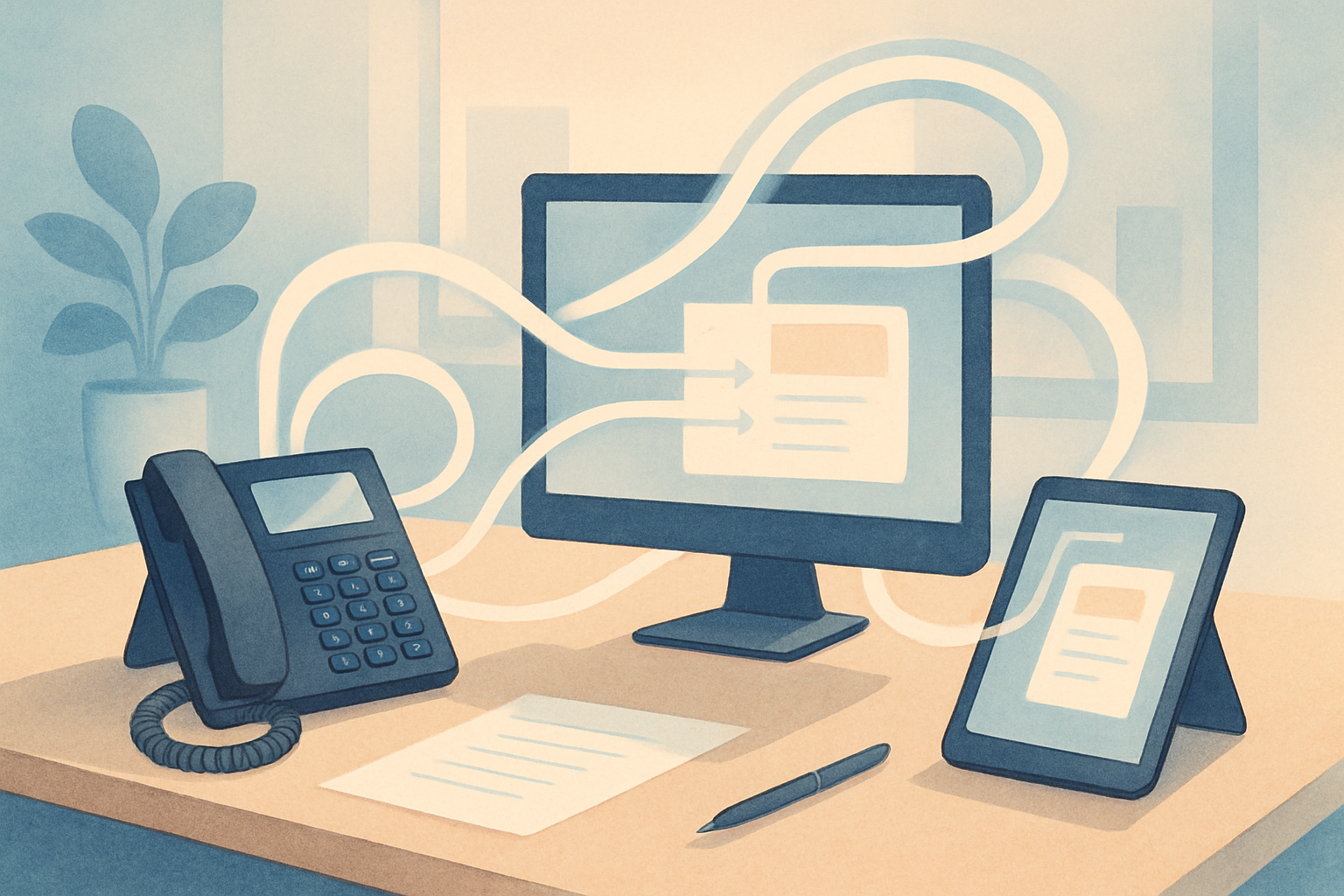
If you run a small UK business with 10 to 50 people, you probably already use AI somewhere. Maybe a chatbot on your website, maybe a transcription tool, maybe a scheduling assistant. But you have also probably noticed that none of these tools talk to each other. Leads still fall through cracks. Someone still copies data from one screen to another. Agentic AI for small business is the shift from individual tools doing isolated tricks to intelligent agents that handle entire workflows across your existing systems, without you manually stitching them together.
This article explains what agentic AI actually means in practical terms, what it can do for a business your size, and how to think about deploying it without ripping out the tools you already rely on.
Quick answer
Agentic AI uses autonomous agents that can perceive a trigger (like a missed call), make decisions (is this a qualified lead?), take actions (log it in your CRM, create a follow-up task, notify a team member), and learn from results. Unlike a chatbot, which waits for instructions, an agentic system acts across multiple tools on your behalf. For a small business, this means fewer manual handoffs, faster response times, and operational consistency even when your team is stretched.
What is agentic AI, and how is it different from a chatbot?
A chatbot is reactive. It sits on a webpage, waits for someone to type something, and responds from a script or a language model. That is useful, but limited.
An agentic AI system is proactive. It monitors triggers, reasons about what needs to happen next, and executes a chain of actions across different systems. Think of it less like a tool and more like a capable colleague who never forgets a step.
For example, a Voice AI agent can answer a missed call, qualify the caller by asking the right questions, log the lead details into your CRM, assign a follow-up task to the right team member, and send a confirmation to the caller. That entire sequence happens without anyone on your team lifting a finger.
The difference matters because most small businesses do not have spare capacity. You do not need another tool that creates more admin. You need agents that eliminate it.
What workflows can an AI agent actually automate?
The best place to start is wherever your team currently does repetitive, multi-step work that crosses between systems. Here are common examples we see in UK small businesses:
- Missed call recovery: A Voice AI agent answers, qualifies the caller, logs the details, and routes warm leads to the right person.
- New enquiry processing: An agent picks up form submissions, checks for duplicates, enriches the record, creates a task, and triggers an appropriate response.
- Appointment scheduling and reminders: An agent books the appointment, updates your calendar, confirms with the customer, and sends reminders at intervals you choose.
- Invoice chasing: An agent monitors outstanding invoices, sends reminders at set intervals, escalates to a human if payment remains overdue, and updates your records.
- Daily operations briefing: An agent compiles key numbers from your systems overnight and delivers a summary to your inbox before you start work.
None of these require your team to copy data between screens, remember to follow up, or check three different platforms. The agent handles the workflow end to end.
Do I need to replace my existing tools?
No. This is one of the most common concerns we hear, and the answer is straightforward. Agentic AI works with the tools you already have. Your CRM, your calendar, your accounting software, your phone system. The agent sits on top and connects them.
The value is not in replacing your tech stack. It is in making your existing tools finally work together as one intelligent automation workflow. A well-built custom automation connects your systems so data flows automatically and actions happen in the right order, every time.
You do not need a massive IT budget or a digital transformation programme. You need someone who understands your processes and can build agents around them.
Why this matters now for UK small businesses
UK businesses are spending more on AI tools than ever. But productivity gains have been modest for many SMBs, and the reason is tool sprawl. Adding another standalone AI product creates another silo. Another login. Another thing to check.
Agentic AI operational efficiency comes from integration, not accumulation. When your ai agents business processes are connected into a single workflow, you remove the gaps where things get lost, delayed, or forgotten.
For a team of 15 or 30 people, that can mean saving hours every week. Not in theory. In actual time that someone on your team currently spends copying, chasing, and checking.
How to get started without overcomplicating it
You do not need to automate everything on day one. Start with one workflow that causes consistent friction. Maybe it is missed calls. Maybe it is new lead follow-up. Maybe it is the weekly reporting that takes someone half a day.
Map the steps. Identify the systems involved. Then build an agent that handles it. Test it, refine it, and expand from there.
If you want to see what this looks like in practice, our case studies show how UK businesses of your size have connected voice, data, and operations into workflows that run without constant human oversight.
Common questions
How can agentic AI connect my phone system, CRM, and admin tasks?
An AI agent acts as a bridge between your systems. When a call comes in, the Voice AI agent captures the information, then uses integrations to log it in your CRM, create follow-up tasks, and notify the right team member. Each step triggers the next automatically. Your phone system, CRM, and task management work as one connected process rather than three separate ones.
Is agentic AI only for large companies with big budgets?
Not at all. Agentic AI for small business is specifically about right-sizing automation to your operations. You do not need an enterprise platform or a dedicated IT team. A single well-designed agent handling one critical workflow can save hours every week and pay for itself quickly. The technology is accessible, and the approach scales with your business.
Want this working in your business?
EngageAI builds practical AI systems for UK teams, from voice agents and workflow automation to reporting dashboards.