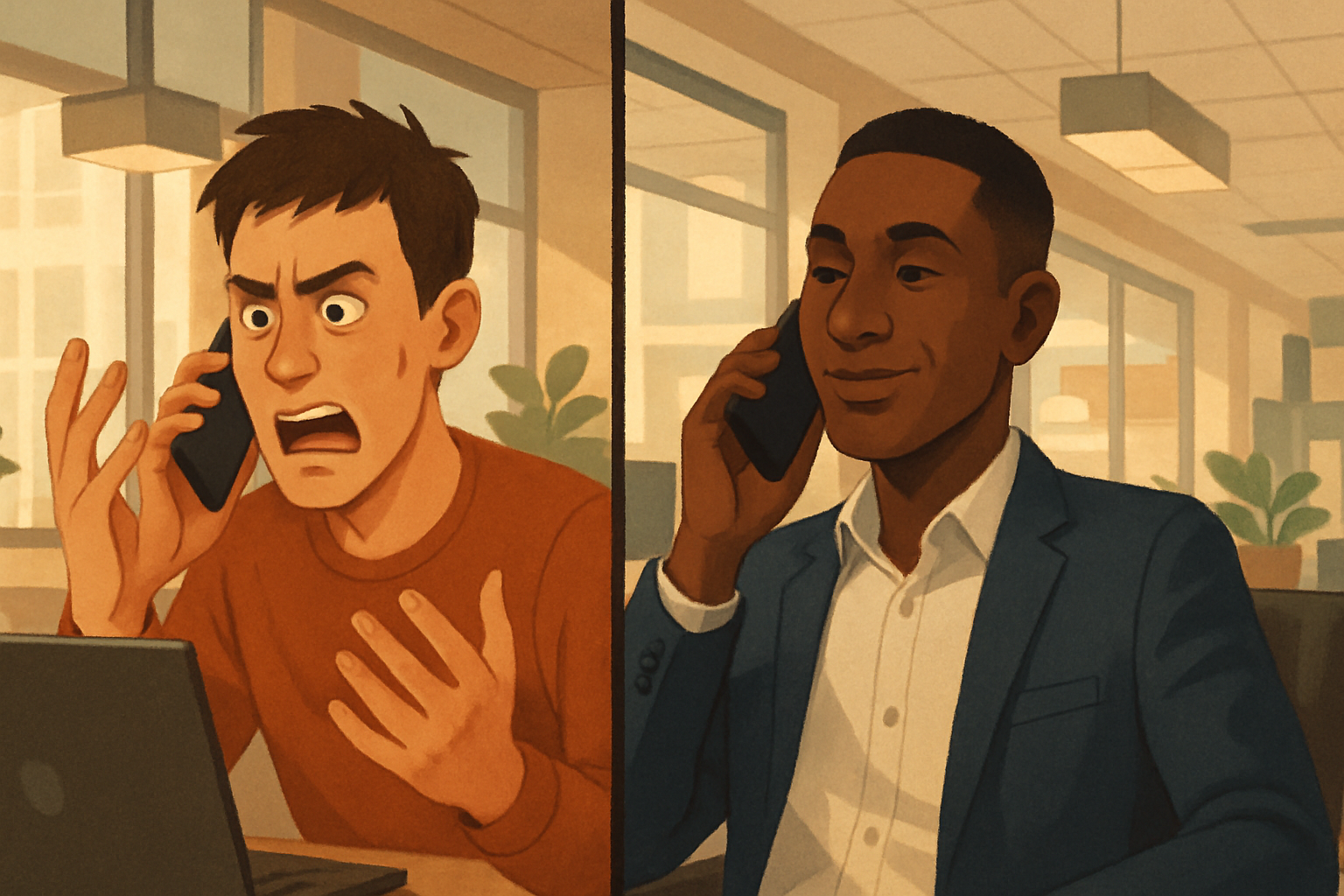
AI voice agent failures in small business are making headlines for all the wrong reasons. A stroke patient left stranded by an AI receptionist. Customers screaming "human" into their phones just to reach a real person. These stories are enough to make any sensible business owner pause before adopting voice AI. But the answer isn't to avoid the technology altogether. It's to understand why failures happen and build proper safeguards so your customers never end up in those situations.
Quick answer
Most AI voice agent failures come down to three things: no clear rules for when to transfer to a human, poor conversation design, and zero ongoing quality checks. When a voice AI agent is well-designed with proper escalation triggers, realistic scope, and regular monitoring, it handles routine calls brilliantly and passes complex ones to your team without friction. The technology works. Bad implementations don't.
What actually causes AI voice agent failures?
When you strip away the headlines, the root causes are surprisingly consistent. Almost every high-profile failure traces back to one or more of these problems:
- No human handoff rules. The AI has no clear criteria for when to stop trying and connect the caller to a person. It just keeps looping, rephrasing, or apologising.
- Overly ambitious scope. The agent is expected to handle everything, including complex complaints, emotional callers, and edge cases it was never trained for.
- Set-and-forget deployment. The business launched the agent, celebrated, and never reviewed call logs or updated the conversation flows.
- Poor conversation design. The scripts feel robotic, the agent doesn't confirm understanding, and there's no graceful recovery when it gets confused.
- No fallback during outages. If the AI system goes down or encounters an error, callers hit a dead end instead of being routed to voicemail or a team member.
Notice that none of these are really about the AI itself being incapable. They're about how it was set up, scoped, and maintained. That distinction matters.
What makes a good AI receptionist vs a bad one
A bad AI receptionist tries to be everything to everyone. It attempts to handle medical emergencies, negotiate contracts, and soothe furious customers, all with the same flat script. Understanding ai receptionist limitations is the first step to avoiding them.
A good AI receptionist knows exactly what it's brilliant at and what it should hand off immediately. For most UK small businesses, that means the agent confidently handles appointment bookings, opening hours queries, basic FAQs, and call routing. Anything outside that scope triggers a transfer.
The difference isn't the technology. It's the thinking that goes into the design before a single call is answered.
When should a voice AI escalate to a human?
Getting the human handoff right is arguably the most important part of any voice AI deployment. When to escalate AI calls should be defined before you go live, not figured out after complaints roll in.
At minimum, your voice AI should transfer to a human when:
- The caller explicitly asks for a person.
- The AI fails to understand the request after two attempts.
- The call involves a complaint, a vulnerable caller, or anything emotionally sensitive.
- The query falls outside the agent's trained scope.
- The caller's tone signals frustration or distress.
Modern voice AI can detect these signals reliably. The question is whether anyone bothered to configure those triggers during setup. A well-built system makes the handoff feel natural. The caller barely notices the transition. A poorly built one makes them feel trapped.
Voice AI quality control: the bit everyone skips
Launching a voice AI agent isn't a one-time project. It's an ongoing commitment, though not a huge one. Voice ai quality control means reviewing a sample of calls each week, spotting patterns where the agent struggles, and updating its responses accordingly.
Think of it like training a new receptionist. You wouldn't hire someone, show them the phone system on day one, and then never check in again. The same logic applies here.
Good quality control looks like:
- Weekly review of flagged or failed calls.
- Monthly updates to conversation flows based on real caller behaviour.
- Tracking transfer rates to spot where the agent needs improvement.
- Testing edge cases before they become real problems.
This doesn't need to consume hours of your week. Most of it can be handled in 20 minutes with the right reporting in place.
How to deploy voice AI safely in your business
If you're a UK small business considering voice AI, the recent headlines shouldn't put you off. They should make you more selective about how you do it. Start with a narrow scope. Define your escalation rules clearly. Test thoroughly before going live. And commit to reviewing performance regularly.
The businesses getting into trouble are the ones who bought a cheap plug-and-play solution, pointed it at their phone line, and walked away. The ones thriving are treating voice AI as a proper part of their team, with guardrails, oversight, and ongoing refinement.
If you want to see how that works in practice, our case studies show real UK businesses running voice AI with proper handoff protocols and quality checks built in.
Common questions
Is voice AI safe for customer-facing calls in a small business?
Yes, when it's properly designed with clear escalation rules and regular quality reviews. The failures making headlines come from poor implementation, not from voice AI being inherently risky. A well-scoped agent that knows when to transfer to a human will handle routine calls efficiently and protect your customer relationships.
How quickly can I tell if my voice AI is failing?
Within the first week if you're monitoring properly. High transfer rates, repeated caller complaints, and calls where the agent loops without resolution are all early warning signs. Review a sample of calls in your first few days and adjust before small issues become big ones.
Next steps
If you're evaluating voice AI for your business and want to get it right from day one, we can help you scope, build, and monitor an agent that actually works. No set-and-forget nonsense. Get in touch and we'll walk you through what a safe, effective deployment looks like for your setup.
Want this working in your business?
EngageAI builds practical AI systems for UK teams, from voice agents and workflow automation to reporting dashboards.