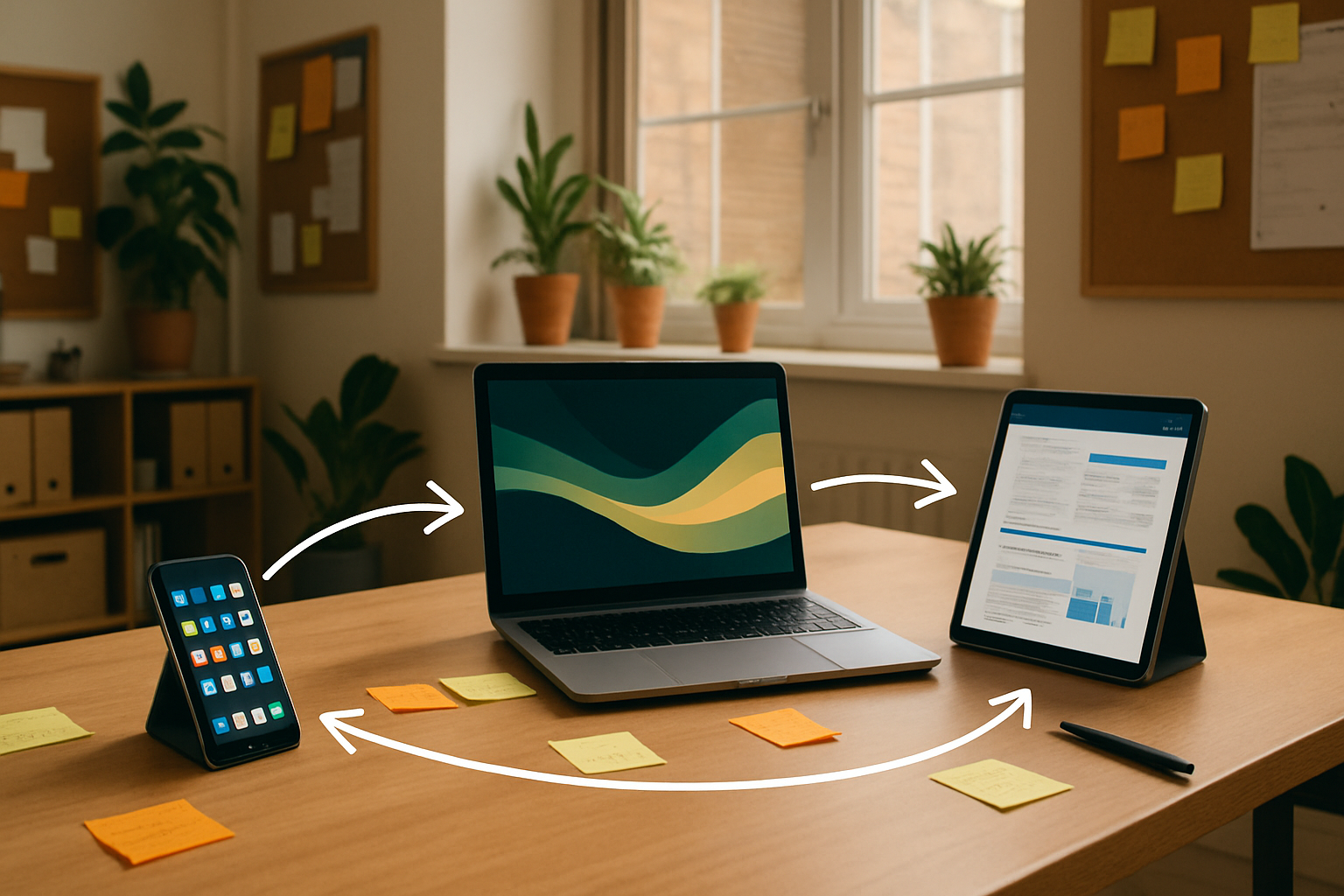
If you've invested in AI tools for your business and still find your team copying data between spreadsheets, chasing invoices by email, or manually updating your CRM after every phone call, you're not alone. Business automation UK is booming in spend but lagging badly in results. Recent IDC research suggests inefficient AI use could cost UK businesses over £6 billion. The problem isn't the tools themselves. It's how they're connected, or more often, how they aren't.
This article is for the operations manager or business owner at a 10 to 50 person UK SMB who has bought the AI tools, paid the subscriptions, and is still wondering where the time savings went.
Quick answer
Most UK SMBs deploy AI tools in isolation. A chatbot here, an AI email assistant there, maybe an automated scheduler that doesn't talk to your CRM. Without connected workflows, each tool creates its own data silo and your team still bridges the gaps manually. Custom business automation that links your existing tools into a single workflow is where the ROI actually lives.
The £6 billion question: where is the money going?
SAP's latest UK research found that 8 in 10 British businesses are actively pursuing AI-driven growth. That's encouraging. But the same data reveals that digital immaturity is blocking progress for the majority of them.
Snowflake's analysis backs this up, suggesting UK businesses are leaving significant AI productivity gains on the table. Not because AI doesn't work, but because implementation is fragmented.
The pattern looks something like this:
- A business buys three or four AI-powered tools across sales, admin, and customer service.
- Each tool works well enough on its own.
- None of them share data or trigger actions in the others.
- Staff spend hours each week doing the manual handoffs between systems.
- The AI investment delivers a fraction of its potential, and people start questioning whether it was worth it at all.
That last point is the real danger. Not the wasted spend itself, but the growing scepticism that AI can help at all. It absolutely can. It just needs to be wired up properly.
Why isolated AI tools fail small businesses
Think of your business operations as a relay race. AI tools are your fastest runners. But if nobody passes the baton, it doesn't matter how fast anyone can sprint.
When your phone system doesn't update your CRM, your CRM doesn't trigger your invoicing, and your invoicing doesn't feed your reporting, every transition is a manual task. That's where errors creep in, follow-ups get missed, and your team burns hours on admin instead of serving customers.
Workflow automation for small business isn't about replacing people. It's about removing the tedious handoff work that sits between the valuable tasks your team actually needs to do.
What connected business automation looks like
Imagine a customer calls your business. A Voice AI agent handles the initial enquiry, qualifies the lead, and books an appointment. That booking automatically appears in your calendar and CRM. A confirmation goes out to the customer. Your sales team gets a summary with context. After the appointment, a follow-up task is created and tracked.
No one copied and pasted anything. No one forgot to log the call. No one chased a colleague for notes.
That's not a fantasy. That's what custom business automation does when your tools are properly connected. It's the difference between owning AI and actually using it.
How to tell if your AI investment is underperforming
You don't need a consultant to spot the warning signs. Ask yourself these questions:
- Is your team still manually entering the same data into more than one system?
- Do customer enquiries sometimes fall through the cracks between tools?
- Are you paying for AI subscriptions that only one or two people actually use?
- Does your reporting require someone to pull numbers from multiple places and combine them in a spreadsheet?
- Have you heard "it's quicker to just do it myself" from more than one team member?
If you answered yes to two or more of those, your AI inefficiency cost is likely significant. Not necessarily in subscription fees, but in the staff time, missed opportunities, and operational friction that disconnected tools create.
What to do next
Start by mapping your current workflows end to end. Where does data move between systems? Where does a human have to bridge the gap? Those manual handoffs are your biggest opportunities.
Then look at whether your existing tools can be connected through automation, or whether you need purpose-built workflows. Most UK SMBs already own the right tools. They just need them talking to each other.
If you want to see what this looks like in practice for businesses similar to yours, our case studies show how connected automation delivers measurable time and cost savings.
You don't need to rip out what you have. You need to make what you have work together.
Why isn't my AI investment delivering results?
Usually because your AI tools operate in silos. Each one might work well individually, but without automated workflows connecting them, your team is still doing manual admin to move data and actions between systems. The fix is joining those tools into coherent, automated processes so data flows and tasks trigger without human intervention.
What is business process automation and does my SMB need it?
Business process automation means using technology to handle repetitive tasks and data transfers that currently require manual effort. If your team spends time on data entry, chasing follow-ups, updating records across multiple platforms, or compiling reports from different sources, then yes, your SMB would benefit. For most 10 to 50 person businesses, even automating two or three core workflows can free up significant hours each week.
Want this working in your business?
EngageAI builds practical AI systems for UK teams, from voice agents and workflow automation to reporting dashboards.