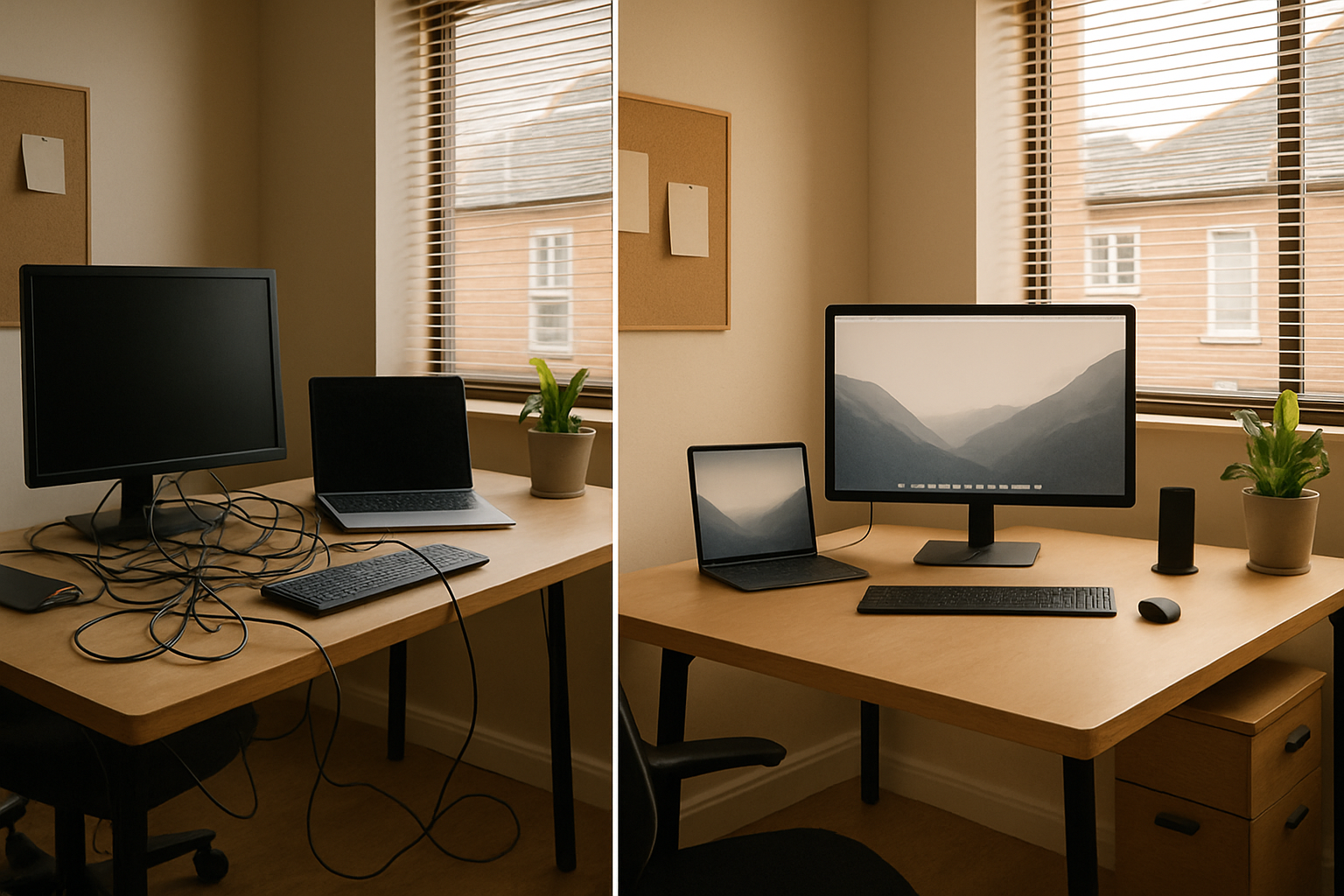
If your business automation isn't delivering what you expected, you're not alone. Eight in ten UK businesses say they want AI-driven growth, yet most are stuck. Off-the-shelf tools sit half-configured. Workflows break between systems. Staff quietly revert to spreadsheets. The gap between automation ambition and automation results is costing UK businesses billions, and small firms feel it hardest. This article explains why business automation in the UK keeps failing for SMBs and what a working approach actually looks like.
Quick answer
Most business automation projects fail because they bolt generic tools onto processes they weren't designed for. UK SMBs get results when automation is built around their actual workflows, tools, and team. That means custom business automation, not another subscription platform you'll abandon in three months.
The £6 billion problem hiding in plain sight
Recent industry analysis suggests that inefficient AI use could soon cost UK businesses more than £6 billion in lost value. That figure isn't just about big enterprises wasting money on flashy pilots. It includes every small business paying for automation software that nobody uses properly, every operations director watching data sit in one system when it's needed in another, and every owner wondering why the "automated" process still needs two people and a workaround.
The pattern is remarkably consistent. A business buys an off-the-shelf automation platform. It handles 60% of the workflow well enough. The remaining 40% either doesn't fit or requires technical skills nobody in the team has. Adoption stalls. The subscription keeps billing. And the manual process never really went away.
Why off-the-shelf automation stalls for UK SMBs
There's no shortage of automation tools on the market. The problem isn't availability. It's fit. Here's what typically goes wrong:
- Generic workflows ignore your real process. Your quoting, onboarding, or fulfilment steps aren't identical to anyone else's. Pre-built templates get you started but can't handle the specifics.
- Integration gaps between tools. Your CRM, finance software, booking system, and spreadsheets don't talk to each other natively. Data gets stuck in silos, and people end up copying information between screens.
- No one owns it internally. Most 10 to 50 person businesses don't have a dedicated automation specialist. The person who set it up moves on, and the logic behind each workflow goes with them.
- Digital maturity varies wildly. SAP research highlights that digital immaturity remains one of the biggest blockers for UK business growth. If your team isn't comfortable with the tools, even good automation gets ignored.
Sound familiar? You're not doing anything wrong. You've just been sold a product that was never designed for how your business actually works.
What working business process automation looks like
Effective workflow automation for small business starts with process, not software. Before a single tool is configured, someone needs to map how work actually moves through your business. Not how it should move in theory. How it moves on a wet Tuesday when your best person is off sick.
From there, custom automation connects the tools you already use. Your CRM, your finance platform, your booking or project system. Rather than replacing everything, you build bridges between them. Data flows. Tasks trigger automatically. Manual steps drop away because the system handles them.
A practical example: a 30-person services firm spending hours each week chasing leads, updating records in two systems, and sending follow-up messages manually. With custom business automation, a new enquiry triggers a CRM update, sends an acknowledgement, and flags the team, all without anyone switching tabs.
Add Voice AI to the front end, and inbound calls get handled, qualified, and routed before a human needs to pick up. That's not futuristic. That's available now for UK SMBs who build it around their own operations.
Build vs buy: a simple decision framework
This is the question most business owners arrive at eventually. Should we keep trying off-the-shelf platforms, or invest in something custom?
Buy off-the-shelf when your process is genuinely standard, your team is technically confident, and you only need one tool doing one job. That works for plenty of simple tasks.
Build custom when your workflow crosses multiple systems, your team has already bounced off a generic tool, or your competitive advantage depends on how you operate rather than what you sell. For most UK SMBs at the 10 to 50 person mark, that second scenario is far more common.
The cost difference is smaller than you'd expect, especially when you factor in the subscriptions, workarounds, and staff time you're currently burning on tools that don't quite work.
How to get business automation right from here
If you've already tried and stalled, the fix isn't another tool. It's a better starting point. Begin with these steps:
- Map your top three most time-consuming internal processes end to end.
- Identify where data gets stuck, duplicated, or manually transferred.
- Ask your team what they actually do versus what the system is supposed to do.
- Talk to an ai automation agency in the UK that works with businesses your size, not enterprise consultancies selling you a six-month discovery phase.
The businesses getting real results from automation aren't the ones with the biggest budgets. They're the ones who started with their own processes and built outward.
Why isn't my business automation working?
Usually because the tools you chose weren't built for your specific workflows. Off-the-shelf platforms handle common tasks well but break down where your processes are unique, where systems don't integrate natively, or where your team lacks the technical skills to maintain the setup. The fix is mapping your real workflows and building automation around them.
Should we build custom automation or buy off-the-shelf tools?
If your workflow crosses multiple systems and your team has already struggled with a generic platform, custom automation will almost certainly deliver better results. Off-the-shelf works when the task is simple and self-contained. For most UK SMBs running interconnected processes across several tools, custom is where the real operational gains come from.
Want this working in your business?
EngageAI builds practical AI systems for UK teams, from voice agents and workflow automation to reporting dashboards.