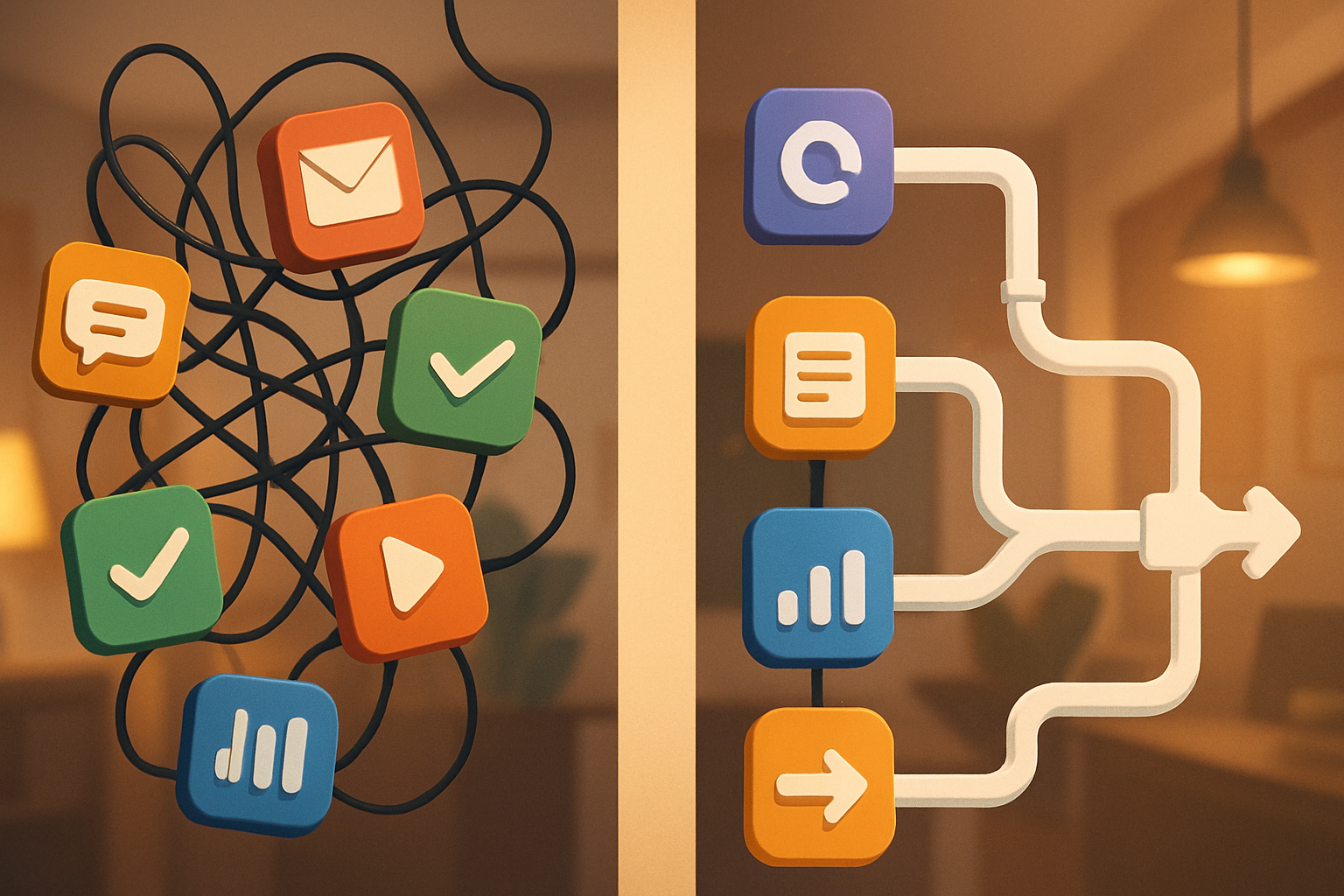
If you've tried an AI tool and wondered where the promised time savings went, you're not alone. Research suggests that inefficient AI use could cost UK businesses over £6 billion annually. But the problem isn't AI itself. It's how it gets bolted on. Most small businesses buy individual tools, plug them in hopefully, and end up with extra admin instead of less. The gap between AI that saves real money and AI that just adds complexity comes down to one thing: whether automation connects to your actual workflows or just floats alongside them.
Quick answer
Most AI automation projects underdeliver because businesses adopt isolated tools rather than building connected, end-to-end workflows. When AI handles a single task but still requires manual steps before and after, you haven't removed the bottleneck. You've moved it. Genuine business automation ROI comes from mapping your real processes first, automating the friction points between them, and measuring the outcome. For a 10 to 50 person UK firm, well-integrated automation can realistically cut 15 to 30 hours of admin per week, compounding savings month after month.
Why most AI automation projects fail to deliver
Eight in ten UK businesses say they want AI-powered growth, according to recent industry surveys. Yet digital immaturity keeps blocking progress. The pattern looks the same across sectors.
- Tool-first thinking. A business buys an AI chatbot, a scheduling tool, or an AI transcription service. Each works fine in isolation. None of them talk to each other or feed into the systems the team already uses.
- No process mapping. Nobody sat down and traced how a lead becomes a customer, how a support query gets resolved, or how invoices move from quote to payment. Without that map, automation has nothing meaningful to attach to.
- Manual glue. Someone still copies data from one system to another, chases updates on Slack, or reformats a spreadsheet every Friday. The AI saved ten minutes. The human glue work still takes two hours.
- No measurement. Without clear before-and-after numbers, nobody can say whether the investment paid off. So the subscription quietly renews while the team quietly ignores it.
These ai automation implementation gaps are why a Snowflake report recently asked whether UK businesses are leaving productivity gains on the table. The answer, for most, is yes.
Disconnected tools vs. real workflow automation
There's a meaningful difference between adding AI to your business and automating your business with AI.
A disconnected tool handles one job. A voice AI agent answers a phone call, for example. Useful. But if the information from that call doesn't automatically update your CRM, trigger a follow-up task, or feed into your reporting, your team still has to do that manually.
Integrated workflow automation connects the steps. The call comes in, the AI agent qualifies the enquiry, the CRM record updates, the right person gets notified, and the follow-up is scheduled. No copying, no chasing, no Friday afternoon data entry.
That's the difference between spending money on AI and getting business automation ROI from it.
What a practical AI adoption strategy looks like for UK SMBs
Forget the hype. A solid ai adoption strategy for a UK business with 10 to 50 people looks like this.
1. Audit your admin friction. Spend a week noting every task that involves copying information between systems, chasing someone for an update, or doing repetitive data entry. These are your automation candidates.
2. Map the workflow, not the tool. Before choosing any software, draw the process from trigger to outcome. Where does a customer enquiry start? What happens at each stage? Where do things stall?
3. Automate the connections, not just the tasks. The value is in the joins. A Voice AI agent that handles inbound calls is good. One that also logs the call, updates your pipeline, and sends a confirmation to the customer is significantly better.
4. Measure before and after. Track hours spent on admin, response times, error rates, or whatever matters most to your operation. If you can't measure the improvement, you can't justify the spend.
5. Start small and expand. Pick one workflow. Automate it properly. Prove the saving. Then move to the next. This avoids the common automation execution problems that come from trying to automate everything at once.
How much can AI automation actually save a small business?
Numbers vary by sector, but here are realistic benchmarks for UK SMBs we've seen.
A services business with 20 staff automated inbound enquiry handling and follow-ups. Result: 18 hours per week returned to the team. That's roughly the equivalent of a part-time hire, without the recruitment cost.
A trades firm automated job scheduling, customer confirmations, and invoice generation across their existing tools. Admin time dropped by around 25%, and missed appointments fell noticeably within the first month.
With 2026 tax changes and rising operational costs on the horizon, these savings aren't trivial. They compound. Month one saves 15 hours. Month six, with refinements, saves 25. The maths gets increasingly hard to argue with.
You can see more examples of this on our case studies page.
Frequently asked questions
Why do most business automation projects fail to deliver ROI?
Most fail because they automate individual tasks without connecting them to the broader workflow. The AI handles one step, but manual effort still fills the gaps between systems. Genuine ROI requires end-to-end automation that removes the admin friction, not just speeds up a single part of it.
What's the difference between disconnected AI tools and real workflow automation?
Disconnected tools work in isolation. They might answer calls, generate text, or sort emails, but they don't pass information to your other systems automatically. Real workflow automation connects each step so data flows from trigger to outcome without manual intervention, saving significantly more time and reducing errors.
Your practical next step
If you suspect your current AI tools aren't paying for themselves, start with the audit. Track your team's repetitive admin for one week. Note where information gets copied, where tasks stall, and where someone has to chase for an update.
That list is your automation roadmap. And if you'd like help turning it into connected workflows that actually reduce costs, that's exactly what we build at EngageAI. Pick the workflow that frustrates you most, and let's see what the numbers look like.
Want this working in your business?
EngageAI builds practical AI systems for UK teams, from voice agents and workflow automation to reporting dashboards.